

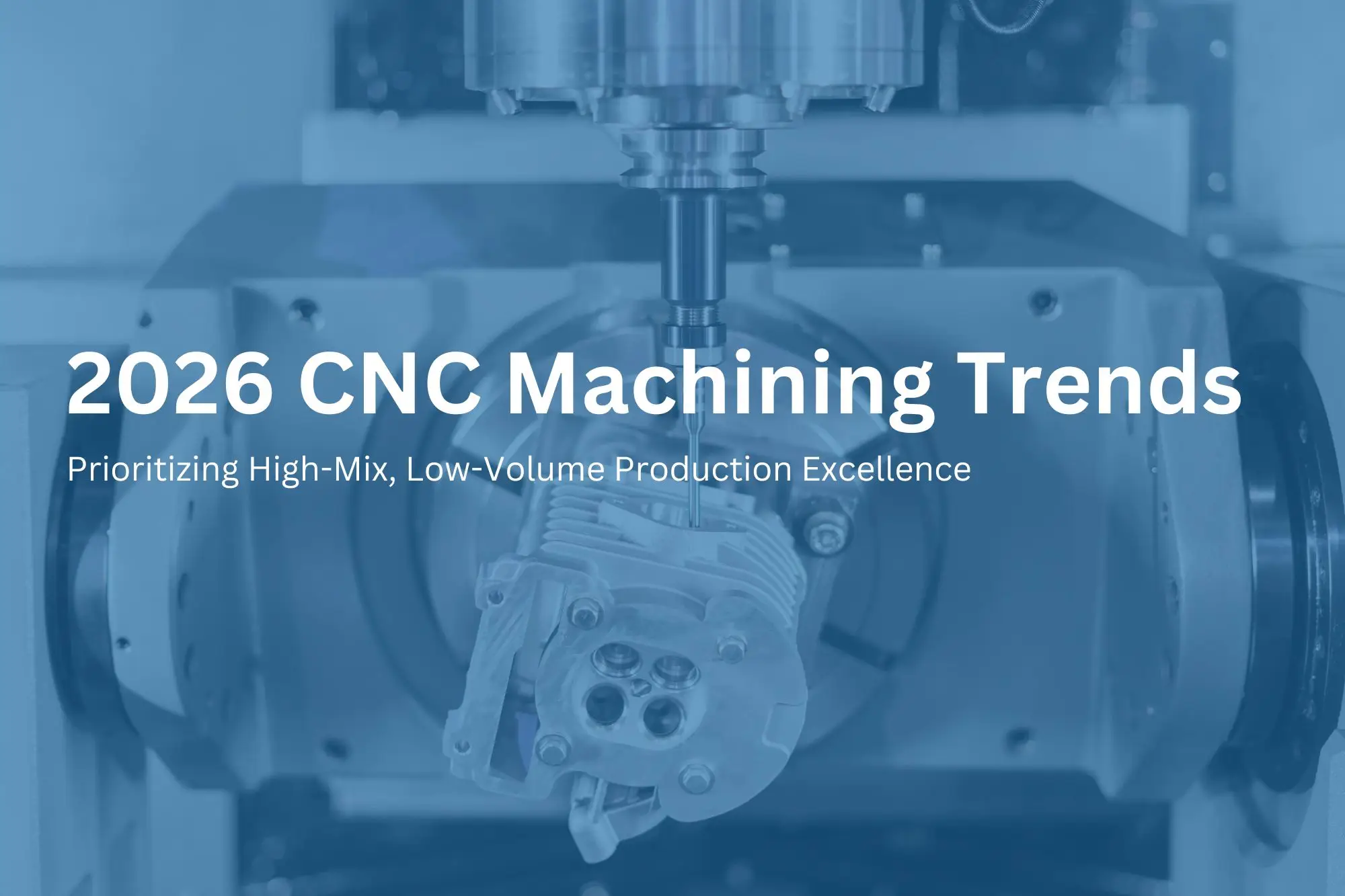
Many CNC machine shops focus on high-volume production. They search for orders yielding 10,000 parts or more per year. However, Ben Machine is differentiated from them because we focus on high-mix, low-volume work that emphasizes front-end setup and programming.
As we look ahead, 2026 CNC machining trends continue to reshape how manufacturers approach the production of complex parts. Rapid advancements in digital technologies, machining strategies, and materials are creating new opportunities for shops that specialize in precision manufacturing rather than mass production.
In this article, we focus on the trends in high-mix, low-volume CNC machining services that help improve efficiency and reduce setup and programming time for complex, low-volume parts. Key developments include AI-assisted programming, hybrid manufacturing approaches, digital twin simulations, advanced material capabilities, and efficiency improvements tailored for HMLV environments.
Together, these innovations are helping CNC manufacturers support industries where precision and complexity matter most, including aerospace, defence, medical, and advanced equipment manufacturing.
The High-Mix, Low-Volume CNC Machining Niche
High-mix, low-volume (HMLV) CNC and high-volume production are two distinct manufacturing approaches catering to different market needs and production requirements.
HMLV manufacturing, or make-to-order manufacturing, involves producing various products in small quantities. This approach is characterized by its flexibility to quickly adapt to changing customer demands and market trends. It allows the creation of unique, complex products with specific quality requirements, and batches often contain fewer than 50 parts.
In contrast, high-volume or mass production focuses on manufacturing large quantities of standardized parts or products. The key characteristic of high-volume production machining is a reduced cost per unit.
HMLV companies operate in environments with high product variety and low production volumes, making them particularly sensitive to market fluctuations. Tailored trend analysis enables us to respond quickly to changes in customer preferences and market trends. Trend analysis also helps identify and capitalize on emerging niche market opportunities before competitors.
Industries such as aerospace, defence, and advanced equipment manufacturing increasingly rely on this manufacturing model. Many of their components are highly specialized, require tight tolerances, and are produced in small batches rather than mass quantities. Design engineers working in these sectors often prefer CNC partners that can adapt quickly to complex part geometries, design revisions, and prototype iterations.
For companies operating in this niche, CNC machining trends are especially important because the technologies driving efficiency in small-batch production directly affect lead times, programming complexity, and overall manufacturing flexibility.
Advancements in Efficiency and Precision (5-Axis Machining & Workholding)
Advancements in machining technology play a key role in improving efficiency and precision in high-mix, low-volume production. Innovations in 5-axis machining, workholding, and simulation are helping manufacturers reduce setups, optimize performance, and streamline complex workflows.
5-Axis Machining for Complex, High-Precision Parts
One impactful trend in HMLV production is simultaneous 5-axis machining, which enables higher precision and accuracy in the production of complex parts with fewer setups. The ability to approach a workpiece from multiple angles simultaneously enables machining intricate shapes and contours within a single setup while maintaining optimal cutting angles, resulting in superior surface finishes. The 5-axis machine provides tighter tolerances and reduces errors associated with multiple setups.
Removing more material with each tool pass shortens cycle times, and maintaining optimal cutting angles reduces tool wear and extends tool lifespan.
Advanced Workholding for Reduced Setup Time
Advanced and adaptable workholding solutions play a critical role in reducing setup time. By securely holding parts in place during machining, these solutions help maintain precision across multiple setups, ensuring parts are consistently produced to exact specifications. Using flexible workholding solutions also saves considerable time and effort by eliminating the expense of making unique, complex fixtures that need to be amortized over a small number of parts.
Coupled with simulation software, these technologies enable manufacturers to streamline workflows, optimize machining parameters, and predict potential issues before they occur. By focusing on these front-end improvements, companies can significantly reduce the overall lead time for complex parts.
Advancements in CAM and Toolpath Verification
Simulation tools themselves are evolving quickly. Modern CAM platforms can now perform advanced toolpath verification, machine kinematic simulation, and collision detection before a part ever reaches the shop floor. Some systems even simulate full machining environments, including workholding and tooling interactions. These capabilities help engineers validate manufacturability early in the design process and reduce costly trial-and-error during production.
Many of these capabilities are also laying the groundwork for digital twin technologies, which allow manufacturers to replicate machining operations virtually and refine them before cutting material.
AI-Assisted Programming & Automation
Artificial intelligence is emerging as one of the most influential trends in CNC machining in 2026, particularly for manufacturers operating in high-mix, low-volume environments.
AI-assisted CNC programming is increasingly being integrated into modern CAM software platforms. These systems analyze part geometry, historical machining data, and tool libraries to automatically generate or optimize toolpaths. By automating portions of the programming process, manufacturers can significantly reduce the time required to prepare complex parts for production.
For HMLV shops, where every new job often requires unique programming, these efficiency gains are especially valuable. AI-assisted systems can help:
- Automatically suggest optimal cutting strategies
- Optimize toolpaths for efficiency and tool life
- Reduce programming errors
- Accelerate setup for complex geometries
AI is also improving inspection and reporting processes. Automated data analysis can streamline quality reporting and measurement verification, reducing the time spent documenting inspection results while maintaining strict quality standards.
Digital Twin Technology
Closely related to AI developments is the concept of digital twins. A digital twin is a virtual representation of a physical part, machine, or machining process. Using digital twins, manufacturers can simulate entire machining operations before production begins.
This approach allows engineers to:
- Detect collisions or toolpath issues
- Evaluate machining efficiency
- Validate setup strategies
- Optimize processes before cutting the material
For HMLV production, digital twins reduce risk and accelerate iteration cycles. Prototype parts, engineering revisions, and small production runs can be refined quickly without costly physical trial runs.
Hybrid Manufacturing
Hybrid manufacturing is another important development shaping CNC machining. This approach combines additive manufacturing (3D printing) with traditional subtractive CNC machining within the same production workflow.
Rather than machining a part entirely from solid stock, additive processes can first build near-net-shape components. CNC machining is then used to finish critical surfaces, hold tight tolerances, and achieve precise geometries.
This combination provides several advantages:
- The ability to produce complex internal geometries
- Reduced material waste
- Faster prototyping and development cycles
- More efficient use of expensive materials
Hybrid manufacturing has gained particular traction in industries such as aerospace and defence, where components may involve intricate shapes, lightweight structures, or internal cooling channels.
For high-mix, low-volume environments, hybrid manufacturing offers additional flexibility. Small batches of specialized parts can be produced more efficiently, and design engineers can explore innovative geometries that would be difficult or impossible to produce using conventional machining alone.
While hybrid manufacturing is not entirely new, it continues to gain importance as additive technologies mature and integrate more seamlessly with traditional CNC processes.
Advanced Material Solutions
Another key trend influencing CNC machining is the growing use of advanced and difficult-to-machine materials.
Industries such as aerospace, defence, energy, and medical device manufacturing increasingly rely on materials like:
- Titanium alloys
- Nickel-based superalloys
- High-performance composites
- Hardened steels
These materials provide significant performance advantages, including higher strength-to-weight ratios, improved heat resistance, and longer service life. However, they also pose major machining challenges due to their hardness, heat generation, and tool wear.
To address these challenges, CNC machining technologies continue to evolve. Several advancements are helping manufacturers machine these materials more effectively, including:
- Improved cutting tool materials and coatings
- High-speed, high-torque spindles
- Advanced cooling and lubrication strategies
- Sophisticated toolpath strategies designed for difficult materials
Successfully machining advanced materials requires a combination of specialized equipment, programming expertise, and deep process knowledge. For companies producing precision parts with complex geometry, selecting a CNC partner experienced with these materials can significantly improve part quality, reduce lead times, and increase overall project success.
Lean Manufacturing in HMLV Environments
Lean manufacturing is another significant trend in HMLV production. Manufacturers can adopt lean manufacturing principles to streamline processes in these environments. In contrast to high-volume production, where efficiency improvements focus on eliminating labour through automation, lean practices in small-batch production are more focused on reducing waste and improving workflow efficiency.
Some lean practices that support HMLV machining environments include:
- Documenting all steps in the production process for each service offering
- Identifying waste and inefficiencies specific to each service stream
- Reducing setup times through flexible workholding solutions instead of unique and costly fixturing
- Speeding up programming and inspection times using AI-assisted programming and reporting methodologies
- Improving lead times for diverse service ranges
Even as advanced technologies such as AI and digital twins become more common, lean manufacturing principles remain essential. Lean practices ensure that new technologies are implemented effectively and that workflow improvements translate into real operational gains.
In many cases, lean thinking complements automation and AI by ensuring that processes remain streamlined, measurable, and adaptable.
Staying Ahead of Specialized CNC Machining Trends
Ben Machine stays ahead of the trends most relevant to our unique HMLV manufacturing model and customer base. Our 5-axis machine tools offer simultaneous machining, where the part and the cutting tool move together, saving time in the machining.
Ben Machine follows trends such as advanced workholding solutions, simulation, high-speed spindles, and lean manufacturing principles to impact and support our specialized manufacturing processes. These trends provide strategic advantages for our clients in defence, aerospace, and other sectors that require precision engineering and HMLV manufacturing.
We also closely monitor emerging developments such as advanced materials, AI-driven programming, and evolving CNC technologies that improve programming speed, machining accuracy, and process reliability.
Moreover, tailoring manufacturing processes to the specific needs of these industries, rather than a one-size-fits-all approach, ensures customers receive high-quality, customized solutions for their unique applications.
Final Thoughts
At Ben Machine, we have strategically invested in the latest CNC machine technology, including our many 5-axis machine tools capable of multiple operations on one machine and setup. Our clients see lower part costs, higher quality, and reduced lead times as benefits of our industry expertise.
Our focus on quality control propels our industry leadership and enables us to deliver value, precision, and turnkey engineering support for complex aerospace and military programs.
As CNC machining trends continue to reshape the industry, choosing a manufacturing partner that invests in evolving technologies and advanced capabilities becomes increasingly important. Companies that stay ahead of these developments are better equipped to deliver precision parts efficiently in complex, small-batch production environments.
Explore the high-mix, low-volume manufacturing processes Ben Machine offers and discover how we can help your company.
