

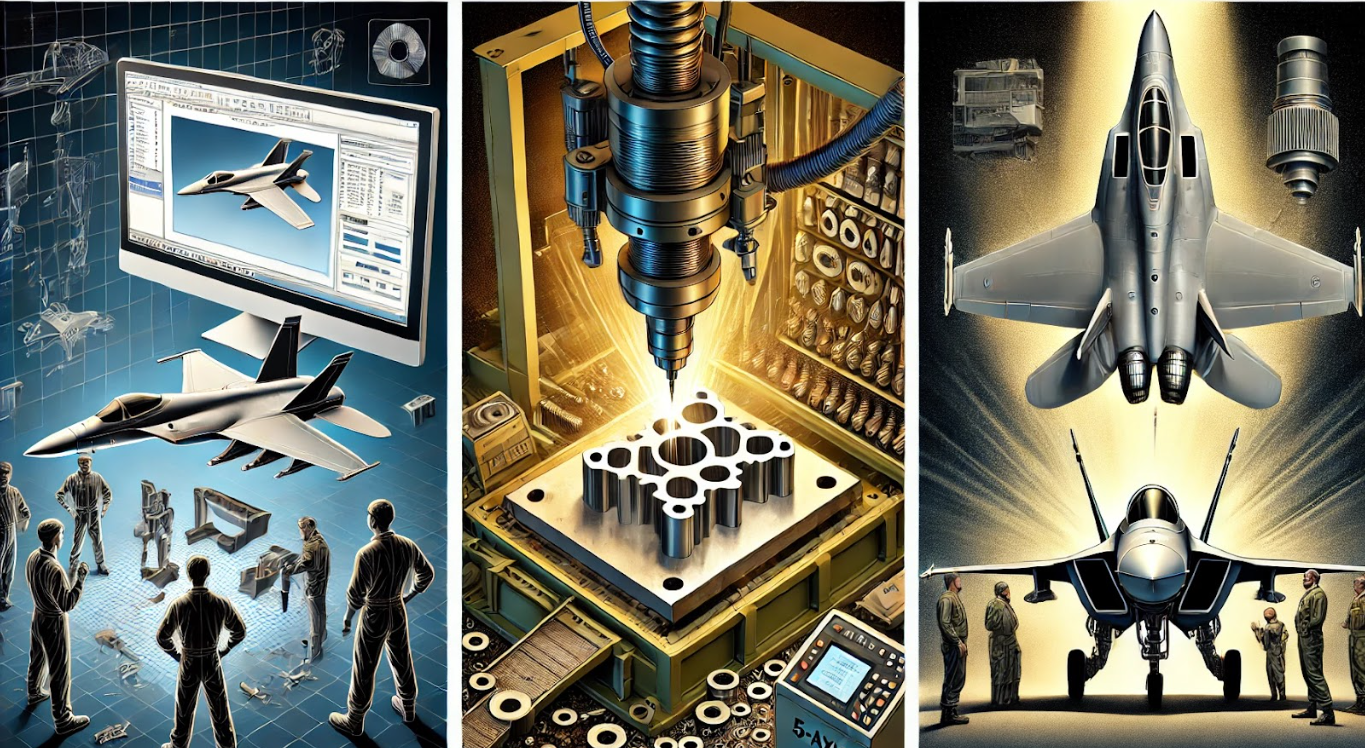
CNC machining delivers unmatched precision, enabling the streamlined production of intricate military components with the tightest tolerances. From design to deployment, Ben Machine ensures the integrity and precision of military components, committed to quality at every step.
Manufacturing critical defence components transforms a digital concept into a functional part for demanding conditions. It starts with engineering design and material selection and moves through precision machining, inspection, assembly, and finishing. Each step meets strict standards for accuracy, reliability, and traceability.
This process relies on close collaboration. Engineers set performance requirements and tolerances. Machinists translate these into manufacturable parts using advanced CNC, while traceability and documentation verify each step essential for performance and safety.
CAD and Engineering Design
The journey begins with engineering design. We work closely with defence clients to refine designs for the CNC manufacturing process. Specifications are tailored to military needs for durability, functionality, and manufacturability, ensuring machined components perform under extreme conditions and at minimal cost.
Our contribution at Ben Machine is to transform these designs into robust, manufacturable solutions that meet military specifications before advancing to CNC machining.
Design for Manufacturability (DFM)
Design for manufacturability (DFM) is vital here. Even complex designs may need refinement for efficient, consistent CNC production.
Through DFM analysis, engineers and machinists evaluate elements such as:
- Feature accessibility for cutting tools
- Wall thickness and structural integrity
- Tolerance feasibility
- Toolpath efficiency and machining strategy
This review helps identify challenges before production. Early problem-solving improves reliability, reduces lead times, and controls costs.
Collaboration Between Engineers and Machinists
Manufacturing critical defence components requires constant communication between engineers and machinists. Engineers provide system expertise; machinists share insights into tools, machines, and materials.
This collaboration preserves design intent and optimizes manufacturing. Machinists may suggest minor changes to radii, hole placement, or tolerances to improve machinability while maintaining performance.
Material Selection for Aerospace and Defence Components
Material selection is crucial. Defence uses metals that withstand intense stress, temperature shifts, and harsh environments.
Common materials used in defence machining include:
- Aerospace-grade aluminum alloys
- High-strength stainless steels
- Titanium and titanium alloys
- Nickel-based superalloys
Each material presents unique machining challenges, such as hardness, heat, and tool wear. Early planning matches machining and tooling to each material’s properties.
Simulation and Prototyping
Simulation and prototyping validate designs before production. Digital simulations assess structural behaviour, stress, and thermal performance.
CNC prototyping produces physical components for testing. Prototypes confirm function, validate tolerances, and indicate improvements before production, reducing risk for defence systems.
CNC Precision Machining and Advanced Manufacturing
With the design in place, we transition into the computer-controlled machining process. This phase involves converting CAD data into CAM instructions, generating precise G-code, and setting up the machinery for the project. Our advanced manufacturing capabilities ensure that each defence component is produced with unparalleled precision and accuracy, meeting the stringent requirements of the defence industry.
To support high-precision machining, we utilize cutting-edge technologies like multi-axis CNC machines and specialized tools. At Ben Machine, we also focus on future-proofing our processes, continually innovating to stay ahead of the evolving needs of the defence sector.
For instance, our dip brazing technology offers a precision solution for joints that are difficult to access, creating seamless and highly durable bonds that surpass traditional welding methods. This innovation is particularly beneficial for complex configurations that demand intricate and secure connections.
Multi-Axis CNC Machining
Modern defence CNC-machined components often have complex geometries unsuitable for traditional three-axis machining. Multi-axis CNC machines—especially 5-axis systems—let tools approach the part from multiple directions in a single setup.
This capability provides several advantages:
- Machining parts with complex surfaces and contours
- Reducing the number of setups required
- Improving dimensional accuracy
- Enhancing surface finish
By reducing repositioning, 5-axis machining increases efficiency and precision—essential for components with tight tolerances.
Machining Complex Geometries
Military and defence systems use complex components with intricate internal features, angled surfaces, and fine dimensions, such as brackets, heat exchangers, housings, and guidance system parts.
Advanced CNC machining produces these geometries accurately while maintaining strict tolerances. Sophisticated toolpath strategies and high-performance tooling ensure consistent results across production runs.
Working with High-Performance Materials
Defence uses advanced metals like titanium, aluminum alloys, and hardened steels. These materials are strong and durable but difficult to machine. Specialized cutting tools, optimized speeds, and advanced cooling maintain precision and reduce tool wear. Skilled machinists ensure consistent quality.
Repeatability and Scalable Production
Consistency is crucial in defence manufacturing. Once validated, machining produces identical parts with minimal variation. CNC machining uses automated toolpaths and digital controls to match every component to specifications as production scales.
Automation and Advanced Tooling
Automation is playing an increasingly important role in defence manufacturing. Automated tool changers, pallet systems, and monitoring software boost efficiency and precision. Combined with high-performance tooling and modern CNC platforms, these technologies let manufacturers build complex defence components reliably and efficiently.
Quality Control and Inspection
At Ben Machine, we consider quality control to be the foundation of everything we do. Each component undergoes a thorough inspection to ensure it meets the precise specifications required for defence applications. This process not only involves cutting-edge technology but also a dedicated team of experts who meticulously examine every detail of each part.
Our commitment to quality goes beyond simply meeting industry standards. We adhere to and exceed the rigorous benchmarks of AS 9100D and ISO 9001:2015. Every part we produce is subjected to an array of industry-leading testing methods, ensuring it will perform reliably in mission-critical environments. This focus on quality guarantees that components are always delivered to specifications, contributing to the safety and success of military operations.
Dimensional Inspection with CMM Technology
Coordinate Measuring Machines (CMMs) use a probe to measure parts in three dimensions, inspecting complex shapes and verifying that all features meet required specifications and tolerances.
CMM inspection ensures critical dimensions—such as hole locations, surface profiles, and geometric relationships—match design specifications.
Traceability and Documentation
Traceability is vital in defence manufacturing. Each component is fully documented, including origin, machining, inspection, and finishing. This documentation provides accountability and enables contractors to verify each part’s integrity throughout its lifecycle.
Material Certification
Material certification confirms that raw materials meet requirements. Certifications list chemical composition, mechanical properties, and origin. These records confirm materials used in defence components meet strict regulatory and performance requirements.
Non-Destructive Testing (NDT)
Non-destructive testing methods identify internal defects or structural issues without damaging the component. Common techniques include:
- Ultrasonic testing
- Dye penetrant inspection
- Radiographic inspection
These methods detect flaws such as cracks or voids that may not be visible during standard inspections.
By combining advanced inspection tools and rigorous documentation, manufacturers ensure every component meets the highest standards of reliability and safety.
Assembly and Finishing
Once machining is complete, the next phase is assembly and finishing. Our assembly teams are well-equipped to handle the most challenging projects, bringing manufactured components together into complex systems while adhering to international standards. By leveraging our expertise, we ensure that every assembly is built to perform flawlessly, meeting or exceeding the requirements of AS9100.
In addition to assembly, Ben Machine provides a comprehensive suite of metal finishing services to protect components in transit and ensure they are ready for immediate deployment. From anodizing and chromate conversion to plating and non-destructive testing, our on-site finishing capabilities ensure the durability and longevity of every part, even in the harshest conditions.
Finishing processes play a crucial role in defence applications. Many components must operate in environments that expose them to moisture, temperature extremes, vibration, and corrosive elements. Surface treatments such as anodizing or specialized coatings provide essential corrosion resistance and protect components from wear.
These finishing processes also enhance durability and extend the service life of critical components. For parts exposed to heavy mechanical loads or friction, surface treatments can improve hardness and reduce the risk of premature failure.
Once finished, components may be integrated into larger defence assemblies or systems. Careful documentation accompanies each step of this process to ensure full traceability and compliance with defence program requirements. This preparation ensures that every component is ready for deployment and can perform reliably in demanding operational environments.
Case Study: Overcoming Challenges and Driving Innovation
Real-world manufacturing projects highlight the complexity involved in producing critical defence components. These projects often require engineering creativity, advanced machining expertise, and close collaboration between teams to deliver a reliable solution.
Throughout our history, Ben Machine has consistently pushed the boundaries of what’s possible in defence manufacturing. When an aerospace systems supplier needed to reconfigure aerospace technology for the land-based vehicle market, they came to us with a challenge: help us create an updated design for terrestrial applications that is scalable for mass production.
We were engaged because of our expertise in cost-effective, precision manufacturing engineering. Our experts worked with our customer’s design and engineering teams to meticulously dissect the original aerodynamic features and tailor a robust, economical design for land vehicles that met market demands.
Our joint efforts with the client’s design team enabled the removal of non-essential airborne capabilities, resulting in a streamlined, market-competitive system that maintained the technological excellence of its aeronautical lineage.
The journey to creating these critical components began with a 3D CAD design, which was iterated and refined until it became a working final product capable of operating in the most demanding environments.
Frequently Asked Questions for Machining Critical Components in Defence
What materials are commonly used in manufacturing critical components for defence?
Defence components are typically produced using high-performance metals capable of withstanding extreme mechanical and environmental conditions. Common materials include aerospace-grade aluminum alloys, stainless steel, titanium, and nickel-based superalloys. These materials offer high strength-to-weight ratios, corrosion resistance, and durability—qualities essential for military equipment and vehicles.
What capabilities should defence contractors look for in a CNC machining partner?
When selecting a CNC machining partner, defence contractors should look for several key capabilities, including:
- Multi-axis CNC machining capabilities
- Experience in machining advanced materials
- Tight tolerance expertise
- Strong quality control systems
- Advanced inspection technologies such as CMM
Equally important is the ability to support high-mix, low-volume production environments, where manufacturers must adapt quickly to evolving defence program requirements.
How does prototyping support the development of defence components?
CNC prototyping allows engineers to test and evaluate component designs before moving into full production. Physical prototypes help confirm dimensional accuracy, validate functionality, and identify potential improvements.
By testing prototypes early, engineering teams can reduce risk, refine performance, and ensure the final component meets operational requirements.
How are defence components prepared for harsh environments?
Defence components are often exposed to extreme operating conditions, including moisture, vibration, temperature fluctuations, and chemical exposure. Finishing processes such as anodizing, plating, and specialized coatings help protect components from corrosion and wear.
These treatments extend component lifespan and improve reliability in challenging environments.
How does CNC machining support modern defence programs?
CNC machining enables manufacturers to produce complex, high-precision components that meet the demanding requirements of modern defence systems. The technology supports both rapid prototyping and scalable production while maintaining tight tolerances and consistent quality.
As defence systems continue to evolve, CNC machining remains a key technology for defence manufacturing critical components with precision and reliability.
Final Thoughts
Ben Machine excels in producing high-quality, reliable defence components through advanced machining operations and precision engineering. Our dedication to exceeding industry standards and our ability to innovate in the face of complex challenges consistently meet the evolving demands of the defence sector. As a trusted industry partner, we are committed to supporting future defence needs with the same excellence and reliability that has defined our work.
With extensive expertise in manufacturing critical defence components, our team works closely with engineers and procurement teams to transform complex designs into precision-machined components that perform in demanding operational environments. Through collaboration, advanced machining technologies, and rigorous quality processes, we ensure every part meets the strict standards required by modern defence programs.
Connect with Ben Machine for high-quality CNC machining services and partnerships, or to learn more about our capabilities in defence component manufacturing.
